
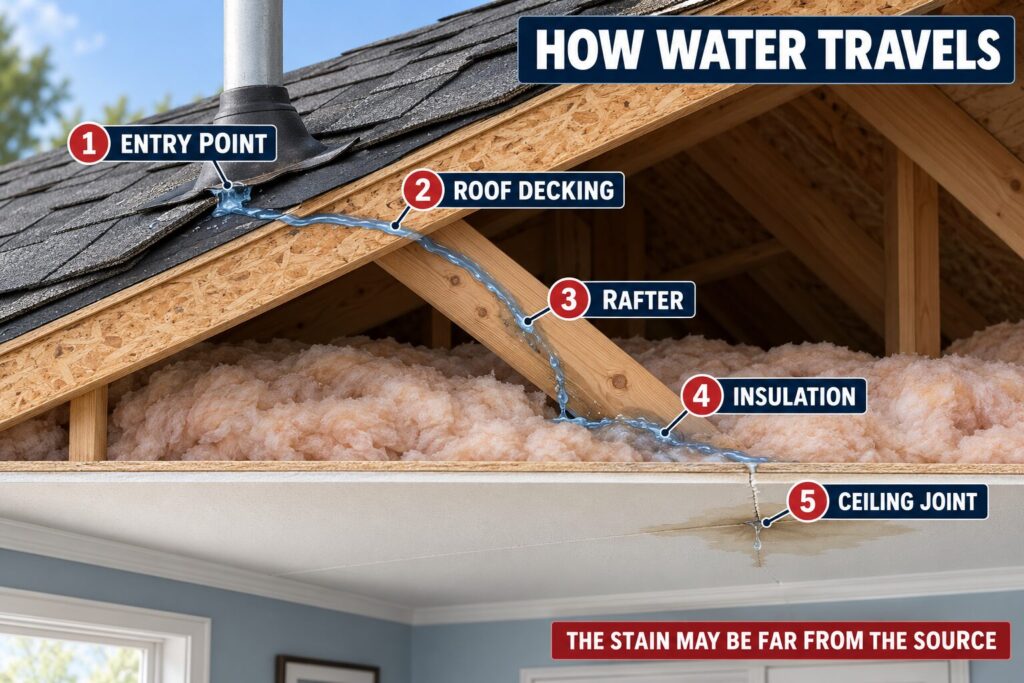
Hidden roof leaks can be confusing because the place where water enters the roofing system may not be where it finally appears inside the home. Water can travel across decking, follow a rafter, move around a pipe, soak into insulation, and collect at a ceiling joint before producing a visible stain.
That is why pointing to a ceiling spot does not always identify the necessary roof repair. Finding the actual source requires examining the roof, attic, weather conditions, and route the water may have followed.
Why Hidden Roof Leaks Are Difficult to Trace
Gravity pulls water downward, but buildings contain many surfaces that can redirect it. Roof decking, underlayment, framing, fasteners, pipes, ductwork, and insulation can all influence its path.
A small opening near a vent may allow water beneath the roofing material. From there, the moisture may run along the underside of the decking until it reaches a seam. It can then drip onto a rafter, follow that framing member several feet, and finally reach the ceiling.
The result is a stain that appears far from the original opening.
The source can be even harder to identify when the leak is intermittent. A roof may remain dry during light, vertical rain but leak when wind pushes water beneath a flashing detail from a particular direction.
The Entry Point, Travel Path, and Stain
It helps to think of a leak as three separate locations:
- Entry point: Where water gets through the exterior roofing system
- Travel path: The route it follows through the roof or attic
- Visible symptom: Where the water reaches a ceiling, wall, light fixture, or floor
These locations may be close together, but they can also be several feet apart. Repairing the ceiling stain addresses the visible symptom. It does not stop water from entering the roof.
Even placing a patch directly above the stain may miss the problem. The true entry point could be uphill, beside a wall, around a pipe, or along a nearby valley.
How Water Moves Through a Roof
Roof decking is the wood surface beneath the roofing material and underlayment. If water reaches the decking, it may follow its slope until it encounters a seam, nail, opening, or framing member.
Rafters and trusses can then carry moisture in another direction. Water may cling to the underside of the wood before dripping at a joint or low point. Nails and metal fasteners can also provide a path for individual droplets.
Insulation makes hidden roof leaks more difficult to follow. Fiberglass insulation may absorb or spread moisture before it becomes visible below. Water can also collect on the paper backing or move toward a gap around an electrical box.
Pipes and ducts create additional routes. Moisture may follow a plumbing vent pipe downward or travel along the surface of ductwork before dripping onto another part of the ceiling.
By the time the homeowner sees a brown mark, the water may have crossed several materials and changed direction more than once.
Common Sources of Water Intrusion
Water can enter through damaged roofing material, but open roof surfaces are only part of the inspection. Many leaks begin around locations where the roofing system changes direction or meets another component.
Areas that commonly deserve attention include:
- Valleys where two roof slopes direct water together
- Flashing beside walls, chimneys, and roof transitions
- Plumbing vents and deteriorated pipe boots
- Skylights and their surrounding flashing
- Exposed or backed-out fasteners
- Solar attachments and previous equipment locations
- Low-slope sections connected to steeper roofing
- Previous repairs that no longer remain sealed
An inspection should evaluate these details in relation to the stain, roof slope, and storm direction. Finding cracked sealant somewhere on the roof does not automatically prove it caused the interior damage.
Why Folsom Weather Can Change the Clues
Folsom homes often experience long periods of heat and dry weather before seasonal rain returns. Summer UV exposure can age sealants, pipe boots, and roofing materials. Debris may also collect in valleys and gutters while the weather remains dry.
The first sustained rain can reveal a condition that developed months earlier. However, one storm may produce a leak while another does not.
Wind direction is one reason. Rain pushed against a roof-to-wall transition behaves differently from rain falling straight down. The intensity and duration of a storm also matter. A small drainage restriction may handle a brief shower but struggle during several hours of rain.
This does not mean every stain is caused by the roof. Plumbing leaks, condensation, and heating or cooling equipment can create similar symptoms. The timing, location, and weather history help narrow the possibilities.
Interior Signs Worth Documenting
Leaking roof guidance from State Farm identifies ceiling or wall stains, dampness, mold, and musty odors as possible warning signs. It also recommends observing exterior conditions safely from the ground and contacting a roofing specialist to help locate the source. State Farm®
When you notice possible water intrusion, document:
- The date and approximate time
- Whether it was actively raining
- Rain intensity and wind direction, if known
- The size and location of the stain
- Whether the area felt damp
- Photographs before and after the storm
- Any nearby plumbing, vents, skylights, or mechanical equipment
Do not open a wet ceiling or touch a damp light fixture. Move belongings away from the area and use a container to collect dripping water when it can be done safely. Contact the appropriate professional if electricity, sagging drywall, or substantial water is involved.
How Professionals Trace Hidden Roof Leaks
A professional evaluation begins by collecting evidence rather than assuming the entry point sits above the stain. The inspector may review the interior damage, attic conditions, exterior roof, drainage details, and previous repairs.
Attic access can be especially valuable. Stains on decking, rusty fasteners, damp insulation, or marked framing may help establish a travel path. However, dry weather can make active moisture difficult to locate, and some attic areas may be inaccessible.
Exterior photographs provide another part of the record. Drone images can document valleys, flashing, penetrations, solar attachments, and hard-to-reach roof sections without relying solely on observations from the driveway.
Moisture-detection equipment may help identify damp materials, but a reading still needs professional interpretation. It indicates moisture in a location; it does not automatically identify where the water entered.
A careful inspection brings these clues together:
- Where did the interior symptom appear?
- What roof sections sit uphill from that area?
- Which penetrations or transitions are nearby?
- Under what weather conditions does the leak occur?
- Is there a visible route through the attic?
- Has the area been repaired previously?
The Visible Stain Is Not the Repair Plan
A good repair targets the entry point and the surrounding roofing detail. Covering the ceiling stain, coating a broad area with sealant, or replacing one nearby shingle may not correct the cause.
The appropriate repair depends on what the inspection finds. A failed pipe boot may require a focused repair. A roof-to-wall flashing problem may involve siding and several layers of roofing material. A leak beneath tile may require lifting tiles to evaluate the underlayment and flashing below.
Hidden conditions should also be discussed clearly. If water intrusion has continued for an extended period, damaged decking or dry rot may not be fully visible until roofing materials are removed.
That possibility does not justify assuming extensive damage exists. It means the contractor should explain how concealed conditions will be photographed, priced, and approved if they are discovered.
Clear Documentation Supports Better Decisions
Photos make hidden roof leaks easier to discuss because the homeowner and contractor can review the same evidence. Useful documentation may include the interior stain, attic framing, roof overview, suspected entry points, and any concealed damage exposed during repair.
The final explanation should separate confirmed findings from possibilities. Homeowners deserve to know what was observed, what remains uncertain, and why a particular repair is being recommended.
For information about inspections and roofing work in the area, visit our Folsom service page. Our process emphasizes detailed photographs, organized project records, clear explanations, and direct communication throughout the work.
Finding the Real Source of Hidden Roof Leaks
Hidden roof leaks rarely become easier to diagnose when they are ignored. Moisture can damage paint and drywall, affect insulation, stain framing, or contribute to wood deterioration over time.
The important lesson is simple: follow the evidence rather than the stain. The entry point, travel path, and visible damage must be considered together.
A thorough inspection cannot promise to expose every concealed condition immediately. It can provide a logical, documented process for narrowing the possibilities and correcting the source instead of repeatedly covering the symptom.
If you’re not sure what condition your roof is in, you can book your roof inspection online today and we’ll give you clear answers.