
Hillside roof drainage requires more thought than simply attaching gutters and pointing the downspouts away from the house. On a sloped property, water leaving the roof may move quickly across the ground, collect beside a lower level, erode soil, or flow toward another part of the structure.
This matters throughout El Dorado County, especially in hillside communities such as El Dorado Hills, where homes are often built into rolling or steep terrain. Many have multiple stories, stepped foundations, retaining walls, decks, and complicated rooflines. Understanding how water travels from the highest roof plane to its final outlet can help homeowners recognize drainage concerns before winter rain exposes them.
Why Hillside Roof Drainage Behaves Differently
The hillside itself does not determine how quickly rain moves across the roofing material. Roof pitch, surface material, roof length, and rainfall intensity affect that part of the journey. The property slope becomes especially important after water reaches a gutter, downspout, lower roof, or the ground.
On a level lot, a drainage outlet may release water onto an area where it can spread or soak in gradually. On a hillside, the same volume can follow the slope, gain speed, cut channels into exposed soil, or collect against a downhill wall. A drainage plan therefore needs to consider the roof and the surrounding site together.
The goal is controlled movement. Water should be collected where needed, carried through components with adequate capacity, and released at a stable location that does not create a new problem.
Multi-Level Rooflines Move Water in Stages
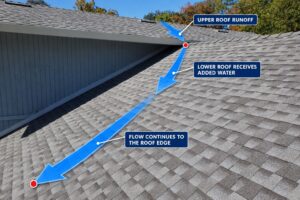
Hillside homes frequently have roof sections at several elevations. An upper roof may drain toward a lower roof, garage, porch, or deck cover before the water finally reaches the ground. Each transition changes the amount and direction of water the next surface must manage.
When an upper downspout releases directly onto a lower roof, runoff becomes concentrated in one location. This is a common hillside roof drainage concern because the roofing, flashing, and lower gutter must handle water arriving from both the rain overhead and the roof section above. Depending on the design, a connected downspout or another controlled path may be more appropriate than allowing repeated discharge across the lower roofing material
Concentrated Valleys Need Careful Attention
A roof valley is the inside angle where two sloping roof planes meet. Because both planes direct water toward the same channel, a valley can carry a substantial amount of runoff during a strong storm.
Complex hillside rooflines may include several valleys feeding one lower roof edge. In a hillside roof drainage system, leaves, pine needles, shingle granules, or small twigs can slow that flow and direct water toward the sides of the valley. Flashing details and installation quality also matter because the valley is expected to manage concentrated water repeatedly.
Gutters Must Match Where Water Arrives
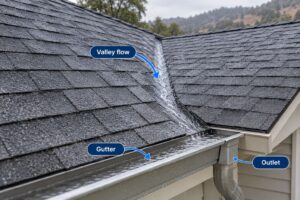
A long gutter does not receive the same amount of water at every point. Valleys and upper roof sections can deliver a heavier flow to one short portion. If the gutter, outlet, or downspout cannot manage that concentration, water may spill over even when the rest of the gutter appears clear.
Gutter performance depends on more than width. Outlet locations, gutter slope, downspout capacity, attachment, roof area, and local rainfall all play a role. Effective hillside roof drainage requires these components to work together. More downspouts are not automatically better if they release water into unsuitable areas.
The USDA’s guidance for roof runoff systems explains that downspout capacity should meet or exceed gutter flow and that water discharged at ground level needs a stable outlet. Current NRCS guidance likewise emphasizes erosion protection and directing runoff away from foundations. 558_final.doc
How Hillside Roof Drainage Affects Downspout Placement
On a hillside, the nearest downhill spot is not necessarily the safest place for a downspout to empty. Water released beside a foundation, retaining wall, walkway, bare bank, or neighboring property may create moisture or erosion concerns.
A suitable outlet could involve an extension, solid drainpipe, approved drainage system, rock-lined area, or another site-specific solution. The correct choice depends on soil, slope, landscaping, foundation design, existing drainage, and local requirements. Underground piping also needs a maintainable route and an outlet that will not clog unnoticed.
Roofers can evaluate how water leaves the roof and gutters. A drainage contractor, landscape professional, geotechnical professional, or civil engineer may be needed when the concern involves unstable soil, retaining structures, major grading, or underground water management.
Sloped-Home Drainage and Soil Erosion
Sloped-home drainage problems do not always begin as a dramatic washout. They may first appear as a narrow channel below a downspout, exposed roots, displaced mulch, bare soil, sediment on a walkway, or a small hollow beside a splash block.
Dry foothill soil can make the problem easy to ignore during summer. When sustained rain arrives, compacted or already saturated ground may accept water more slowly. Runoff then follows the easiest downhill route, which may not be the route the homeowner expected.
Do not solve erosion by casually redirecting water toward another structure, septic area, driveway, or neighboring parcel. The entire discharge path should be considered before changing an outlet.
Warning Signs of Hillside Roof Drainage Problems
Many drainage clues can be observed safely during or shortly after rain. Look for:
- Water overshooting or spilling behind a gutter
- Heavy flow entering one small gutter section
- Upper downspouts emptying repeatedly onto lower roofing
- Soil channels or displaced mulch below outlets
- Standing water near a foundation or retaining wall
- Loose gutters, separated joints, or disconnected extensions
- Persistent staining on fascia, siding, or lower roof sections
One sign does not confirm the cause. A blocked outlet, undersized component, poor gutter slope, roof debris, grading problem, or damaged connection can produce similar symptoms. Photographs taken from a safe location can help document when and where the behavior occurs.
A Complete Inspection Follows the Water
A useful hillside roof drainage inspection should follow the full route of the water. That means starting with roof planes and valleys, continuing through gutters and downspouts, and identifying where each outlet releases runoff.
Drone photographs can document steep or difficult-to-see roof sections without asking a homeowner to climb. Close-up images can show debris, flashing, gutter joints, outlet conditions, and visible wear. An organized photo record also makes it easier to explain which concerns involve roofing work and which may require another specialist.
You can learn more about our roofing services, including inspections, repairs, replacement, and gutter-related work. Our approach focuses on clear photographs, straightforward explanations, organized communication, and owner availability when a project needs additional experience.
Protecting a Hillside Home Starts With Controlled Water
Good sloped-home drainage is not about forcing water away as quickly as possible. It is about collecting it, controlling its path, and releasing it where the property can handle it safely. Multi-level roofs, concentrated valleys, steep terrain, and limited outlet choices make that process more important on foothill properties.
Regular gutter cleaning, storm observations, photo documentation, and professional evaluation can help homeowners understand how their system behaves. When roof and site drainage are considered together, hillside roof drainage becomes easier to maintain and less likely to create surprises downhill.
If you’re not sure what condition your roof is in, you can book your roof inspection online today and we’ll give you clear answers.