
Roof pitch and drainage work together every time it rains. The angle of a roof determines how quickly water moves, where leaves collect, and which roofing systems can do their jobs correctly. On many El Dorado Hills homes, one roof can include several angles over the main house, garage, porch, and additions.
That variety gives a home character, but the entire roof cannot always be treated as one surface. A material that performs well on a steep section may not be appropriate a few feet away on a nearly flat transition.
What Roof Pitch and Drainage Actually Mean
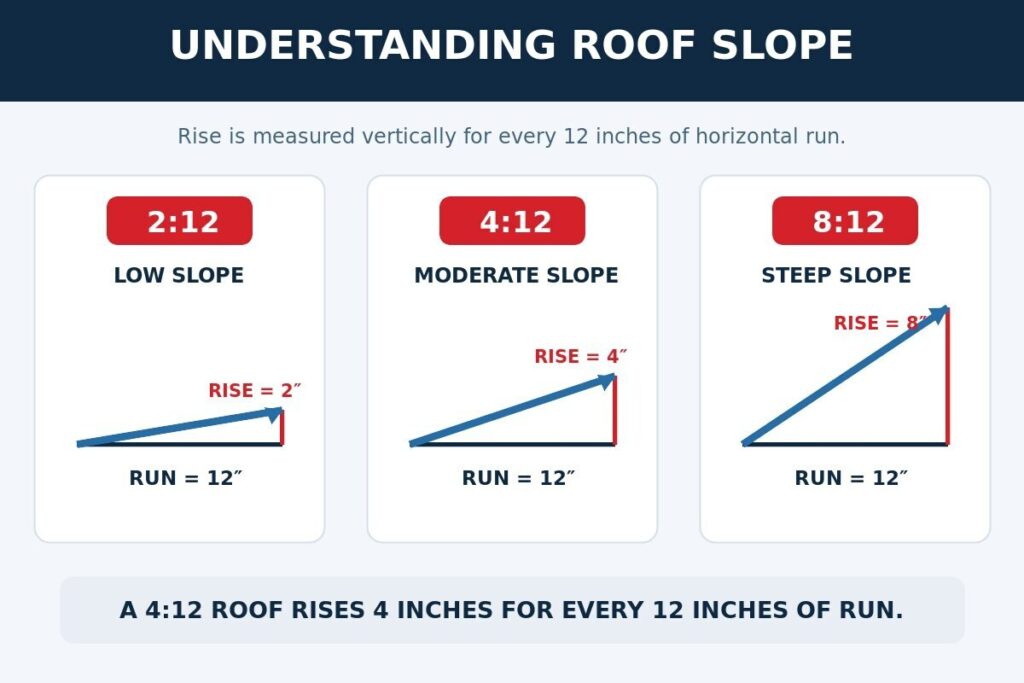
Roof slope is commonly written as a ratio. A 4:12 roof rises four inches for every 12 inches of horizontal distance. People often use “pitch” and “slope” as though they mean exactly the same thing, although their technical definitions differ. InterNACHI offers a helpful explanation of how professionals describe and measure roof slope.
For homeowners, the key idea is simpler: the lower the angle, the more time water may spend moving across the roof. A steeper surface usually sheds rain more quickly. Neither design is automatically good or bad. Each one needs materials and installation details intended for that particular angle.
Steep and Low-Slope Roofs Play by Different Rules
The relationship between roof pitch and drainage becomes easy to see on a steep section. Gravity moves rain toward the eaves quickly, and loose leaves have a better chance of sliding or blowing away. Valleys, gutters, chimneys, and roof-to-wall connections can still interrupt the trip downhill.
Low-slope sections take a different approach. Water moves more slowly, so small installation errors or drainage restrictions can matter more. Wind-driven rain may also travel beneath overlapping materials more easily when the surface is shallow.
Asphalt shingles are designed primarily to shed water. They overlap so water travels down and off the roof; they do not act like a sealed liner. On a section that is too flat for shingles, adding more shingles does not solve the underlying problem.
How Roof Pitch Affects Material Choices
Because roof pitch and drainage affect how water leaves the surface, roofing products have slope limitations. The correct choice depends on the complete system, not just its appearance.
Asphalt Shingles
Asphalt shingles are common on El Dorado Hills homes, but they have minimum-slope requirements. Industry guidance generally treats slopes from 2:12 up to 4:12 as low-slope applications for shingles. Those installations require special underlayment procedures and careful attention to the manufacturer’s instructions and applicable code.
Below the permitted slope, a membrane-style system may be a better fit. Shingles cannot be made suitable for every angle.
Tile Roofing
Concrete and clay tile can perform well on suitable designs, but tile is only the outer, water-shedding surface. The underlayment, flashing, fastening method, slope, and manufacturer’s requirements all matter. A low transition beside a tile roof may need a different system.
Metal and Low-Slope Systems
“Metal roofing” is a broad category. Minimum slopes vary according to the panel profile, seam design, sealant requirements, and tested assembly. Certain standing-seam systems can be used on lower slopes, while other metal products need more incline.
Purpose-built low-slope options include modified bitumen and single-ply membranes. The right answer depends on the design, drainage pattern, and product instructions.
Debris Always Finds the Slow Lane
Roof pitch and drainage also influence where debris settles. Leaves and pine needles have a talent for finding the least convenient part of a roof. In El Dorado Hills, debris from oaks, pines, and landscaped trees may collect in valleys, behind chimneys, along walls, or where a steep roof drains onto a lower section.
Once debris settles, it can slow water, hold moisture, and conceal the surface below. Gutters may overflow when that material reaches the eaves. During a dry summer, everything may appear fine. Sustained rain can reveal that water no longer has a clear route off the structure.
Homeowners should not climb up to investigate. Binoculars, safe ground-level observations, professional photographs, and drone images can provide a much better look without turning roof maintenance into an unwanted adventure.
Underlayment Has a Bigger Job on Lower Slopes
Roof pitch and drainage affect what is needed beneath the visible roof covering too. Underlayment adds a secondary layer of protection. It does not replace correct flashing or a suitable surface material, but it becomes especially important where water drains more slowly.
Asphalt shingles installed within an approved low-slope range may require additional deck protection. The exact procedure depends on current code, the manufacturer, and the complete assembly.
Underlayment is easy to overlook because it disappears when the project is complete. A written proposal should clearly identify what will be installed beneath the finished surface.
Mixed Rooflines Need a Section-by-Section Plan
Many homes are not built with one uninterrupted roof plane. Garages, patio covers, entryways, bay windows, and room additions can create multiple slopes. Sometimes an upper roof even releases water directly onto a lower one.
Reviewing roof slope and water flow together is especially important at these transitions.
That does not automatically indicate a problem. It means the inspection should follow the expected water path. Important questions include:
- Does the upper section concentrate water onto a small area below?
- Is the lower section covered with a compatible material?
- Can debris collect where two different slopes meet?
- Are walls, valleys, and penetrations flashed correctly?
- Do gutters and downspouts carry water away without backing it up?
Homeowners can learn more about our roofing work in El Dorado Hills. Local familiarity is useful because the same roof may need to handle intense summer sun, falling debris, wind, and concentrated winter rain.
Roof Pitch Also Changes Inspection and Installation Safety
The same roof pitch and drainage conditions that affect material selection also change how an inspection is performed. As the roof gets steeper, secure footing becomes more difficult. Even a roof that looks walkable can have loose granules, moisture, dust, or awkward transitions.
Homeowners should leave roof access to trained professionals. Drone inspections can document steep or difficult areas, but the images still need expert interpretation. The goal is to connect visible conditions with the way the roof is designed to drain.
Warning Signs of Roof Pitch and Drainage Problems
You do not need to calculate an angle from the driveway. Instead, watch for visible clues that water or debris may not be moving as intended:
- Debris repeatedly collecting in the same valley or transition
- Watermarks below a porch, addition, or low-slope section
- Gutters overflowing in one concentrated location
- Roofing material that looks different or patched where the angle changes
- Ponding or lingering moisture visible from a safe location
- Interior staining that appears only during heavy or wind-driven rain
These signs do not confirm a diagnosis on their own. They identify areas that deserve a closer look.
The Best Roof Works With Its Shape
Good roofing is not about forcing one product onto every surface. It is about understanding how each section is built and choosing a system that works with its shape. Roof pitch and drainage should be evaluated together with flashing, underlayment, valleys, gutters, penetrations, and the manufacturer’s installation requirements.
A careful inspection can document each roof plane, identify where the angle changes, and show how water is expected to leave the property. Clear photographs and a detailed written scope then give the homeowner something more useful than a one-line recommendation: they provide the reasoning behind it.
If you’re not sure what condition your roof is in, you can book your roof inspection online today and we’ll give you clear answers.